
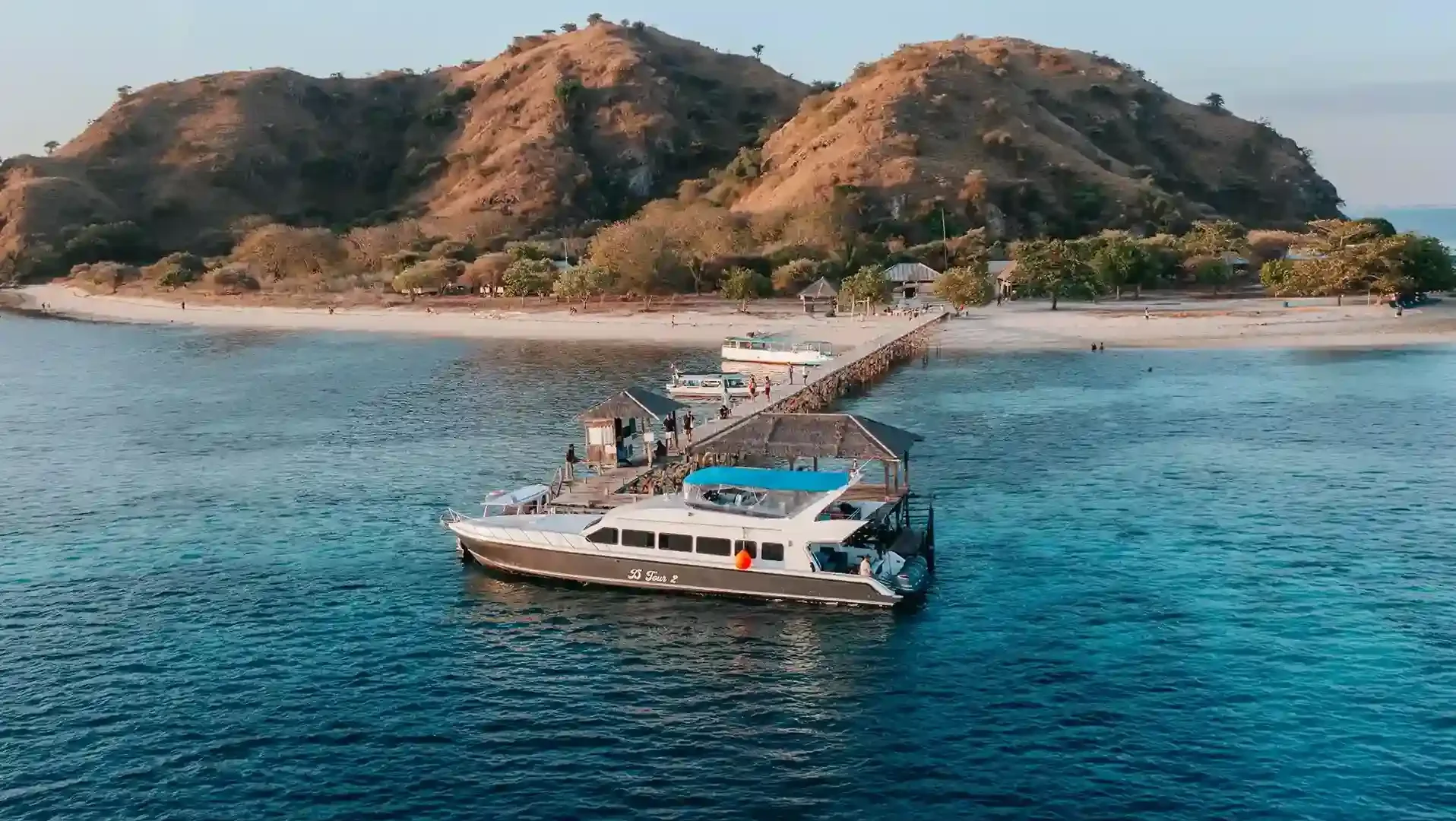
Operator material published through 2025 continues to describe it as healthy and no localised destruction has been reported. However, no site-specific scientific coral-cover or bleaching survey has been published for Kanawa covering 2024–2026, so precise percentage claims from any source should be treated sceptically.
What these two islands are for
Every Komodo route needs a stop where nobody has to think about current. Kanawa and Sebayur are those stops. They sit in the sheltered water north-west of Labuan Bajo, well away from the tidal channels that make Batu Bolong and the Cauldron demanding, and they are the sites crews use for check-swims, first-time snorkellers, night dives and the final morning of a 3D2N route before the boat turns for the harbour.
Kanawa is the more developed of the two: a low island with a long jetty, a small resort footprint, and a fringing reef that begins essentially at the end of the pier and drops away into deeper blue. Sebayur — usually Sebayur Besar, occasionally Sebayur Kecil — sits deeper into the park with a sloping reef running from the shallows past 30 m, which is why it appears on dive itineraries as well as snorkel ones.
Kanawa vs Sebayur at a glance
| Element | Kanawa | Sebayur (Besar) |
|---|---|---|
| Boat time from Labuan Bajo — speedboat | ~40–60 minutes | ~1–1.5 hours |
| Boat time — phinisi / wooden boat | ~1–1.5 hours | ~2–3 hours |
| Reef profile | Fringing house reef off the jetty, shelving to deeper water | Sloping reef from shallows to 30 m+, wall sections at the points |
| Typical snorkel depth | ~2–10 m over the shallow shelf | ~5–15 m over the slope |
| Current | Light to moderate near shore | Light to moderate; stronger at the exposed points |
| Diver suitability | Beginner-friendly; check dives, macro | Beginner to intermediate; soft-coral gardens, reef fish |
| Facilities ashore | Jetty and small resort footprint | Dive-resort footprint on Sebayur Besar; Kecil used as a day beach |
| Usual slot in the itinerary | Final morning before return, or day-one alternative to Kelor | Buffer-day stop on 4D3N, or a night-dive anchorage |
Two of the figures above deserve a caveat. Boat times to Sebayur are operational norms derived from published departure windows rather than a measured schedule, and no operator publishes a distance table for this stretch. We give ranges because ranges are what we can defend.
Reef condition in 2026: what is known and what is not
This is where most operator pages quietly overclaim. Here is the honest position.
What is documented: Komodo National Park sits inside the Coral Triangle and holds more than 1,000 reef-fish species and more than 250 coral species. Operator and guide material published through 2025 continues to describe the Kanawa and Sebayur reefs as healthy and suitable for snorkelling, and no reports of localised destruction — blast fishing, mass anchor damage — have been published for either site.
What is not documented: there is no published, site-specific scientific coral-cover or bleaching figure for Kanawa or Sebayur covering 2024 to 2026. The park as a whole has experienced episodic warming events, as reefs across the region have, but no monitoring report resolves that down to these two islands. Anyone quoting "X% coral cover at Kanawa in 2026" is inventing a number.
What we can tell you from operations: anchor damage near jetties is a known regional problem, and the shallow shelf immediately around a busy pier is always the most worn part of any house reef. Swim outward from the jetty rather than along it, and the reef improves noticeably within fifty metres.
What you will realistically see
| Marine life | Kanawa | Sebayur | Notes |
|---|---|---|---|
| Green and hawksbill turtles | Regular | Regular | Most often over the shallow shelf in the morning |
| Reef fish (anthias, damsels, wrasse, parrotfish) | Abundant | Abundant | The consistent draw at both sites |
| Soft-coral gardens | Present | Strong | Sebayur's slope carries the better soft coral |
| Blacktip reef sharks | Occasional, shallows | Occasional | Juveniles in shallow water; not guaranteed |
| Macro (nudibranch, frogfish, shrimp) | Good | Good | Why these sites appear on night-dive schedules |
| Manta rays | No | No | Mantas are at Karang Makassar and Manta Alley, not here |
Best for — and when to route around them
Best for: non-swimmers and first-time snorkellers who need a calm entry; families with young children; divers wanting an easy check dive or a night dive; anyone whose last morning needs to be gentle before an afternoon flight out of Labuan Bajo.
Route around them if: your priority is manta encounters or drift diving — these are the wrong islands entirely, and the time is better spent at Karang Makassar; or if you are on a compressed 2D1N schedule where every hour of daylight is contested by Padar and the dragon trek.
One practical note for planners: because Kanawa is close to the harbour, it is the stop most often used to absorb schedule slippage. If a route is running late on day three, Kanawa is what gets shortened. Ask your crew where the flex is before you set expectations.
For the two stops that generate the hardest scheduling decisions, see Rinca vs Komodo Island for dragon trekking. If you are still choosing between formats, our day trip versus overnight comparison shows the hours ashore in each. Recurring questions are collected in the 3 Island Liveaboard FAQ hub, and vessel-by-vessel specifications for boats working this stretch are published on komodoboatcharter.com.
Frequently asked questions about Kanawa and Sebayur
Reef condition, snorkelling and where these stops fall.
No. Manta encounters in Komodo happen at Karang Makassar (Manta Point) in the central park and Manta Alley in the south. Kanawa and Sebayur are reef and macro sites.
Yes. Both are sheltered sites with light-to-moderate current near shore and reef starting in shallow water. They are the sites crews commonly use for first water entries and check dives before an itinerary moves to drift locations.
Yes, for beginner to intermediate divers. The reef slopes from the shallows past 30 m with soft-coral gardens and dense reef fish, and stronger current at the exposed points. It is not an advanced site in the way Castle Rock or the Cauldron are.
Roughly 40–60 minutes by speedboat and about 1–1.5 hours by traditional wooden boat or phinisi. It is one of the closest island stops to the harbour, which is why it appears on half-day itineraries as well as multi-day routes.
Kanawa is typically the final morning of a 3D2N route before the boat returns to Labuan Bajo, or occasionally a day-one alternative to Kelor. Sebayur most often appears as a buffer-day stop on 4D3N routes and as a night-dive anchorage.
Kanawa has a jetty and a small resort footprint. Sebayur Besar hosts a dive-resort operation, while Sebayur Kecil is generally used as a day beach. Facilities on both islands are modest and should not be assumed available to passing boat guests without arrangement.
Both are visited as part of Komodo National Park circuits and organised trips include the standard park charges. The precise legal boundary position of each islet is not clearly published, so how your operator itemises the fee may vary — ask for the breakdown in writing.
Arranging a route that includes the calm-water stops
If your group includes non-swimmers, small children, or a diver who has not been in the water for a few years, tell the reservations desk before the itinerary is fixed — the calm-water stops can be weighted more heavily and the drift sites scheduled around them. Komodo Luxury has run island-hopping departures from Labuan Bajo since 2015 and can restructure a private charter route accordingly. Reach the desk on WhatsApp +62 811 9941 919 or at sales@indonesiajuara.asia with your dates, group size and swimming experience.
Boat times are operational norms consolidated from published operator schedules, not measured data. Reef condition described qualitatively because no site-specific 2024–2026 coral survey has been published for either island. Park biodiversity figures per UNESCO and park profile sources. Last reviewed 1 August 2026.