
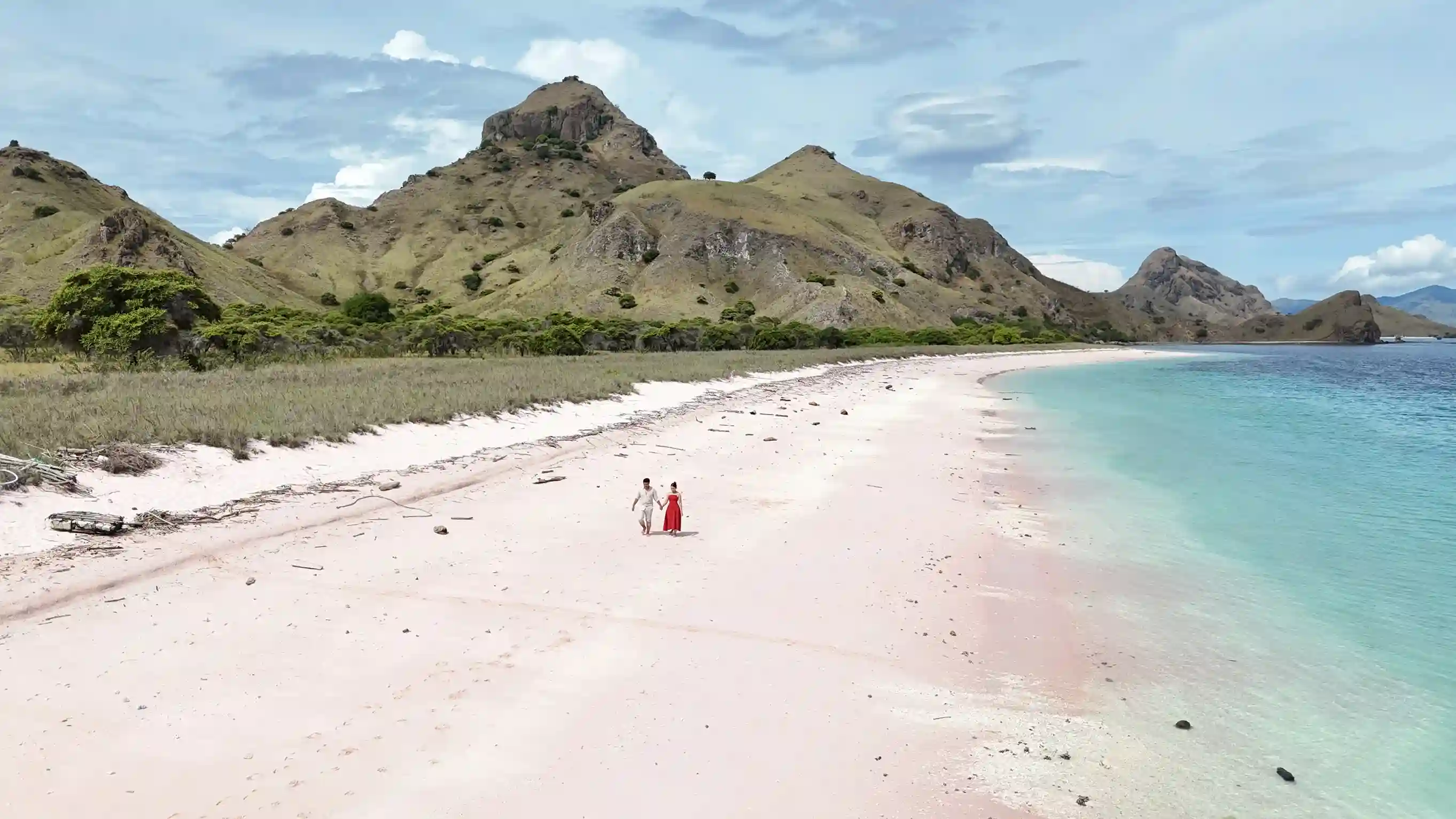
Red-pigmented foraminifera shells and fragments of red organ-pipe coral break down and mix with white coral sand. The blend reads as pink, most visibly at the waterline where wave action concentrates the lighter red fragments.
01
Why Pink Beach is actually pink
The colour comes from the shells of foraminifera — single-celled marine organisms whose skeletons carry a strong red pigment. When those shells break down and mix with white calcium-carbonate coral sand, the blend reads as pink. Fragments of red organ-pipe coral contribute as well. This is the same mechanism behind the handful of genuinely pink beaches worldwide; it is not iron oxide, not volcanic mineral, and not a filter.
What operators rarely say out loud is that the effect is concentration-dependent and light-dependent. The pink fraction is heaviest where wave action sorts the lighter red fragments toward the waterline, which is why the strip within a metre or two of the sea always looks pinker than the dry sand higher up the beach. Wet sand reads pinker than dry sand for the same reason a wet stone looks darker: water reduces scattering and lets the pigment show.
02
When the pink actually shows: hours and light direction
Komodo's Pink Beach faces roughly north-east on the eastern shore of Komodo Island. That orientation determines everything about the photograph you will get. The table below is the practical version of what crews learn by running the stop hundreds of times.
| Time window (WITA) | Light on the sand | How pink it reads | Crowding | Practical note |
|---|---|---|---|---|
| 06:00–08:00 | Low, warm, front-lit from the sea | Strongest — warm light amplifies the red fraction | Very low | Only reachable if your boat anchored overnight nearby |
| 08:00–10:00 | Rising, still angled | Good, especially at the waterline | Rising | The window most 3D2N boats actually arrive in |
| 10:00–14:00 | Overhead, hard | Weakest — washes to pale beige-blush | Peak | Best for snorkelling clarity, worst for the colour |
| 14:00–16:00 | Falling, angled from the west | Recovering | Falling | Water can be choppier as afternoon wind builds |
| 16:00–18:00 | Low, warm, side-lit | Strong again; long shadows | Low | Overnight itineraries only |
One more honest variable: tide. A receding tide leaves a wide band of freshly wetted, sorted sand — the pinkest surface you will see all day. A high tide covers that band entirely. Ask your crew what the tide is doing before you decide where to stand.
03
Pink Beach Komodo is not "Pink Beach Bali"
This confusion sends a steady stream of travellers to the wrong island, so it is worth stating plainly. There is no pink beach in Bali. Searches for "pink beach Bali" usually resolve to one of three things: Pink Beach in Komodo National Park (a 1–1.5 hour flight from Denpasar plus a boat leg), Pink Beach on Lombok/Tangsi in south-east Lombok, or Bali travel agencies selling Komodo trips from Bali offices.
| Name people search | Where it actually is | How you reach it from Bali | Realistic minimum trip |
|---|---|---|---|
| Pink Beach Komodo / Pink Beach Komodo Island | East coast of Komodo Island, Komodo National Park, NTT | Fly DPS → Labuan Bajo (≈1–1.5 h), then boat | 2 days 1 night; comfortably 3 days 2 nights |
| Pink Beach Bali | Does not exist | — | — |
| Pink Beach Lombok (Tangsi/Tangsi Beach) | South-east Lombok | Fly or ferry to Lombok, then ~3 h road | Full day from Kuta Lombok |
| "Pink Beach tour from Bali" | An agency package, not a location | Includes the Labuan Bajo flight and a Komodo boat | Same as Komodo: 2–3 days minimum |
If your search started from Bali, our page on what "Bali to Padar and Pink Beach" really means sets out the realistic options, flights and costs.
04
What else the stop involves
Pink Beach is a swim and snorkel stop as much as a photograph. The reef starts close to shore and shelves gently, with generally light-to-moderate current and depths in the 5–20 m band across the wider dive site. It suits all levels, and it is one of the few places on a Komodo route where strong swimmers and nervous ones can be in the water at the same time without the crew splitting the group. Expect shallow hard-coral garden, anthias clouds and green turtles as a realistic sighting; expect no mantas, which live at the drift sites further north.
There is no infrastructure on the beach. No toilets, no shop, no shade beyond what the boat provides, and no drinking water. Local vendors sometimes moor small boats offshore selling souvenirs; buying is optional and prices are negotiable.
05
Best for — and who will be disappointed
Best for: travellers on overnight itineraries who can arrive before 09:00; snorkellers who want an easy reef with no current management; anyone who values a genuinely unusual geological feature over a saturated Instagram frame.
You will be disappointed if: you expect the bubblegum pink of heavily edited photographs; you arrive between 11:00 and 14:00 on a day trip; or you are visiting in December–March when overcast monsoon light flattens the colour further. We would rather set this expectation now than have you spend a day of your holiday reaching a beach that does not look like the advertisement.
For the neighbouring stop that most people pair with Pink Beach, see Kanawa and Sebayur reef conditions. To place Pink Beach against other Indonesian island-hopping regions, read Komodo vs Gili vs Raja Ampat, and the recurring questions are answered in the 3 Island Liveaboard FAQ hub.
Frequently asked questions about Pink Beach Komodo
Why it is pink, when it looks its best, and what is there.
It is genuinely pink, but far more subtle than most photographs suggest. Expect a blush that is obvious at the wet waterline in soft light and much weaker across dry sand at midday. Most viral images have had saturation pushed heavily.
No. Bali has no pink beach. Searches for one usually mean Pink Beach in Komodo National Park, reached via a 1–1.5 hour flight from Denpasar to Labuan Bajo plus a boat leg, or Pink Beach (Tangsi) in south-east Lombok.
Before 09:00 or after 16:00, ideally on a falling tide. Those windows give warm, angled light and a wide band of freshly wetted sand. Between 11:00 and 14:00 the overhead sun washes the colour out almost entirely.
Yes. The reef begins close to shore and shelves gently, with light-to-moderate current and depths in the 5–20 m band across the wider site. It is suitable for all levels, including first-time snorkellers.
Pink Beach is on Komodo Island, which does have a dragon population, but sightings on the beach itself are incidental and not guaranteed. Dragon viewing is done on ranger-guided treks from the Loh Liang station on Komodo or Loh Buaya on Rinca.
None. No toilets, no shop, no fresh water and no shade beyond what your boat provides. Souvenir vendors sometimes moor offshore in small boats but there is no permanent infrastructure.
Pink Beach is inside Komodo National Park, so the standard park entry applies: IDR 250,000 per foreign visitor and IDR 50,000–75,000 for Indonesian visitors under PP 36/2024. There is no separate Pink Beach ticket.
07
Getting there in the right light
The colour question is really a scheduling question. Boats that anchor overnight in the area put guests on the sand while the light is still low; day boats leaving Labuan Bajo in the morning arrive in the flattest light of the day. Komodo Luxury, operating in Labuan Bajo since 2015, builds Pink Beach into the early part of day two on its 3D2N and 4D3N routes for exactly this reason. To check which 2027 departures anchor nearby the night before, message WhatsApp +62 811 9941 919 or email sales@indonesiajuara.asia.
Colour mechanism per standard marine-geology description of foraminifera-derived sand; park fees per PP 36/2024. Light and tide guidance reflects operational practice, not published measurement. Last reviewed 1 August 2026.